Sometimes, and usually only in part. A gym membership that keeps you fit is a personal cost, even if your physique is your brand. Gym or studio costs you pay specifically to film content or train paying clients are business costs. This guide shows how to tell them apart.
Key takeaways
- An expense must be wholly and exclusively for your business to be allowable.
- Keeping yourself fit has a personal benefit, so a general gym membership usually fails.
- Studio or gym hire paid specifically for filming or coaching clients is allowable.
- A definite business share of a mixed-use cost can be claimed if you can show how you worked it out.
What is the rule for gym costs?
A cost is only allowable if it was incurred wholly and exclusively for your business. HMRC's guidance is blunt: "If one of the reasons is not for business purposes, the expenditure fails the statutory test." There is no general rule that lets you claim a business percentage of a cost with a mixed purpose.
There is one important qualification. Where a definite part or proportion of a cost is wholly for business, that part can be claimed. That is what makes some gym costs claimable.
Can you claim a standard gym membership?
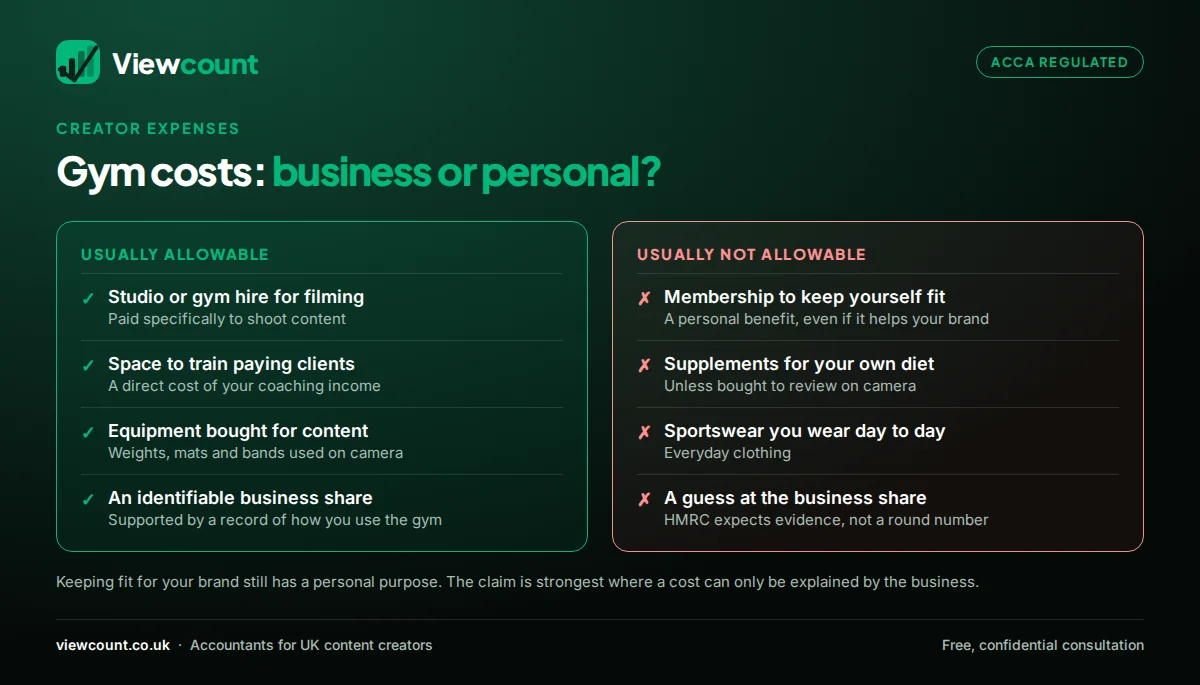
If the membership is how you stay in shape, it has a personal purpose, and HMRC is likely to refuse it. That is true even where your appearance drives your income. Being fit benefits you personally whatever you do for a living.
When are gym costs allowable?
- Hire paid specifically to film. A studio, pitch or gym space booked for a shoot is a production cost.
- Space to train paying clients. If you rent floor space or pay a gym a fee to coach your clients there, that is a direct cost of your coaching income.
- A separate, business-only membership. For example, a second gym you use only to film or coach, alongside the one you train at yourself.
- A definite business share of one membership. If you use the same gym for client sessions and your own training, the client-session part may be claimable, provided you can show how you measured it.
Worked example
Illustration only. Sam pays £60 a month for a gym. Over a typical month Sam logs 30 hours there: 18 hours coaching clients and filming, and 12 hours on personal training. On that record, 18 ÷ 30 = 60% is business use, so Sam claims £60 × 12 × 60% = £432 for the year. If Sam could not show the split, the claim would be hard to defend.
Watch out
A round-number guess such as "50% business" is exactly what HMRC challenges. Keep a log for a representative period and reuse that proportion until your pattern changes.
What other fitness costs can you claim?
- Equipment used for content: weights, bands, mats and filming kit.
- Coaching software and platforms you use to deliver programmes.
- Training that updates your existing qualifications, such as CPD for a personal training certificate.
- Supplements bought specifically to review on camera. Supplements you take as part of your own diet are personal.
Everyday sportswear is treated like any other clothing. See can creators claim clothes, makeup and haircuts?
Want a gym and training claim you can defend? We'll help you work out the split. See our Self Assessment service.
Get in touchHow do you record gym use?
- Log your gym visits for a typical month: date, hours and purpose.
- Keep client booking records and filming schedules that match the log.
- Keep invoices for any studio or space hire.
- Review the split if your routine changes.
FAQs
Sources
- HMRC Business Income Manual BIM37007: wholly and exclusively, apportionment
- HMRC Business Income Manual BIM37400: incidental benefit and dual purpose
- GOV.UK: expenses if you're self-employed, clothing
This article is general information for UK content creators based on HMRC rules and rates at the date reviewed. It is not personal tax advice; your circumstances may differ. Talk to us before acting on it.
Get your fitness expenses right
We'll help you claim what you're entitled to, with records that stand up.
Book a free consultation