Usually not the whole trip. If you'd have taken the holiday anyway, it has a personal purpose and the flights and hotel are not allowable, even if you filmed every day. A trip made only to film is different. This guide explains where HMRC draws the line and what you can still claim.
Key takeaways
- A trip taken purely to create content is business travel and can be claimed.
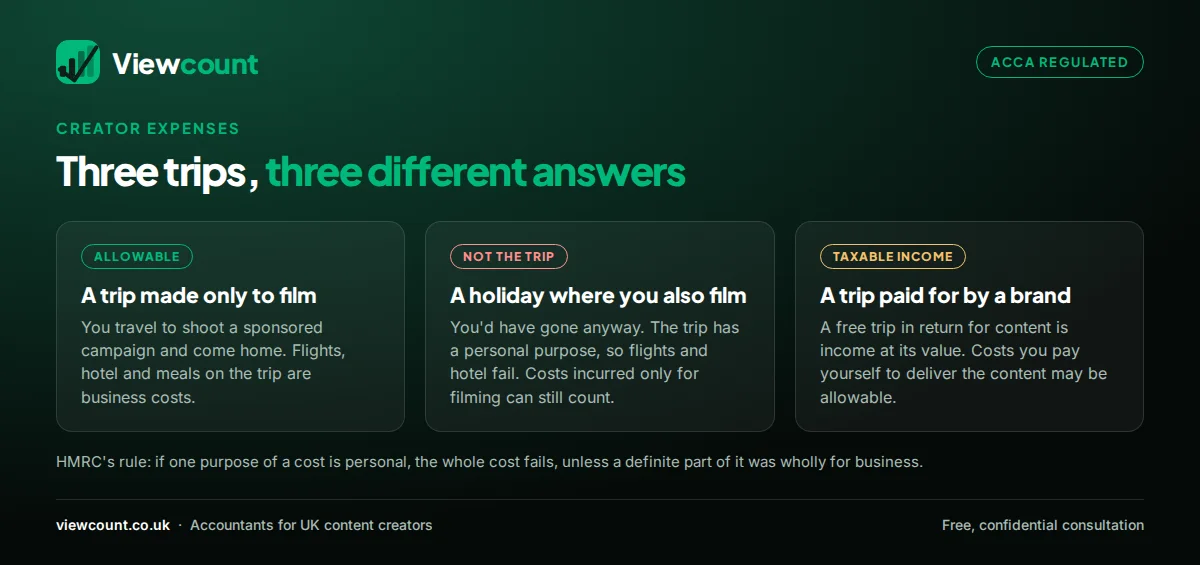
- A holiday where you also film has a personal purpose, so the main trip costs fail.
- Costs incurred only for filming, such as a location fee, can still be claimed on a mixed trip.
- A trip paid for by a brand in return for content is taxable income at its value.
What is the rule for travel costs?
GOV.UK says you can claim business travel costs, including "train, bus, tram, air and taxi fares", "hotel rooms" and "meals on overnight business trips". You cannot claim "non-business driving or travel costs".
The test is whether the trip was wholly and exclusively for your business. HMRC's manual quotes the courts: if an activity is undertaken "with the object both of promoting business and also with some other purpose", the test is not met, even if "the business motive may predominate". A holiday is another purpose.
When is a trip a business trip?
A trip is business travel when content is the only reason you went. Signs that support this:
- You went because of a contract, a campaign brief or a planned series.
- Your time was spent filming, scouting and editing, with a schedule to show it.
- You travelled alone or with crew, not with family or friends on holiday.
- You came home when the work was done.
HMRC accepts that an incidental benefit doesn't spoil a claim. Enjoying a location you had to visit for work is fine, as long as enjoying it wasn't one of your reasons for going.
What if you film on a holiday?
If you booked a holiday and decided to vlog it, the trip has a personal purpose. The flights, accommodation and meals are not allowable, and you can't claim a percentage of them for the days you filmed.
You can still claim costs that exist only because you were filming, where a definite part of your spending was wholly for business. For example:
- A filming permit, location fee or drone licence.
- Equipment hire, or excess baggage for camera kit.
- A paid activity you booked only to film it for a sponsored video.
- Extra nights added solely to complete a shoot, if you can show that.
Worked example
Illustration only. Priya books a week in Lisbon with her partner for £1,800 and films a travel vlog while there. The £1,800 is not allowable. She also pays £120 for a filming permit and £95 to hire a lens: £215 of costs incurred only for the video, which she can claim. Six months later a tourism brand pays her to fly to Madeira alone for three days to shoot a campaign. That whole trip is business travel.
Watch out
Bringing family along doesn't automatically disallow a genuine work trip, but their costs are never claimable, and the more the trip looks like a family holiday, the harder your own costs are to defend.
What about trips paid for by brands?
A press trip or hosted stay given in return for content is generally taxable income at its value, in the same way as a gifted product. Costs you pay yourself to deliver that content, such as travel to the airport, may be allowable. See are gifted products taxable?
Can you claim travel in the UK?
Yes, the same rules apply. Travel to a filming location, a brand meeting or an event you attend for work is business travel. Travel between home and a regular place of work isn't. If you drive, you can use the flat mileage rate instead of actual costs, which for 2026/27 is 55p a mile for the first 10,000 business miles and 25p after that.
Planning a trip that's part work, part holiday? Ask us what you can claim before you book. See our Self Assessment service.
Get in touchWhat records should you keep?
- The contract, brief or content plan that explains why you travelled.
- A shooting schedule or call sheet for the trip.
- Receipts, with filming-only costs marked separately.
- The published content the trip produced.
FAQs
Sources
- GOV.UK: expenses if you're self-employed, travel
- HMRC Business Income Manual BIM37400: incidental benefit and dual purpose
- HMRC Business Income Manual BIM37007: wholly and exclusively, apportionment
This article is general information for UK content creators based on HMRC rules and rates at the date reviewed. It is not personal tax advice; your circumstances may differ. Talk to us before acting on it.
Not sure what your trips cost you in tax?
We'll tell you what's claimable and what isn't.
Book a free consultation