Yes, Making Tax Digital for Income Tax applies to YouTubers, streamers and influencers in the same way as any other sole trader. It started on 6 April 2026 for people with qualifying income over £50,000, and that figure is income before expenses, not profit. This guide covers who is in, when, and what you actually have to do.
Key takeaways
- Making Tax Digital for Income Tax began on 6 April 2026 for sole traders and landlords with qualifying income over £50,000.
- Qualifying income is self-employment and property income before expenses. Salary and dividends don't count.
- The threshold drops to £30,000 from 6 April 2027 and £20,000 from 6 April 2028.
- You keep digital records, send four quarterly updates a year and file your tax return through compatible software.
- HMRC will not apply penalty points for late quarterly updates in the 2026/27 tax year.
Does Making Tax Digital apply to YouTubers and influencers?
Yes. If you create content as a sole trader, your creator income is self-employment income, and Making Tax Digital for Income Tax applies once your qualifying income is over the threshold. It doesn't matter whether the money comes from AdSense, Creator Rewards, Twitch, brand deals or affiliate links.
If you run your creator business through a limited company, the company itself isn't in Making Tax Digital for Income Tax. Dividends and salary from your own company don't count as qualifying income either.
When does Making Tax Digital start for you?
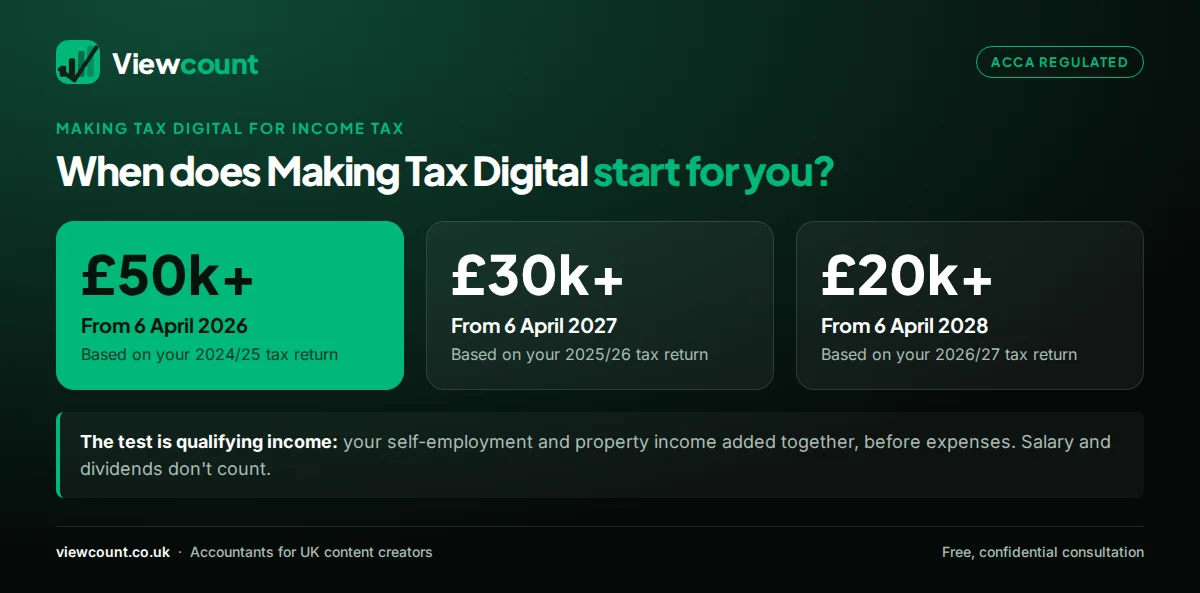
| Qualifying income | Tax return HMRC looks at | You start from |
|---|---|---|
| Over £50,000 | 2024/25 | 6 April 2026 |
| Over £30,000 | 2025/26 | 6 April 2027 |
| Over £20,000 | 2026/27 | 6 April 2028 |
HMRC reviews your Self Assessment return each year and writes to you if you're over the threshold. If you don't get a letter, it is still your responsibility to check.
Is the £50,000 threshold income or profit?
Income. HMRC defines qualifying income as your self-employment and property income added together, "the amount before expenses (also known as turnover)". This is the point most creators get wrong, because their tax bill is based on profit.
Worked example
Illustration only. Jess is a YouTuber who earned £58,000 from AdSense and brand deals in 2024/25 and spent £20,000 on an editor, kit and travel. Her profit was £38,000, but her qualifying income was £58,000. Because that is over £50,000, Jess has had to use Making Tax Digital from 6 April 2026.
What counts and what doesn't
| Counts towards qualifying income | Doesn't count |
|---|---|
| Self-employment income from all your creator work | Salary from a job (PAYE) |
| UK and foreign rental income, including your share of a jointly owned property | Dividends, including from your own company |
| Income from more than one sole trade, added together | Your share of partnership profit |
| Pensions |
Watch out
A creator with £35,000 of channel income and £20,000 of rental income has qualifying income of £55,000. The two are added together, even though neither is over £50,000 alone.
What do you have to do under Making Tax Digital?
- Keep digital records of your income and expenses in compatible software, rather than a paper file or a spreadsheet you total up in January.
- Send a quarterly update for each income source. These are summaries of income and expenses, not tax returns.
- File your tax return through the software by 31 January, as now.
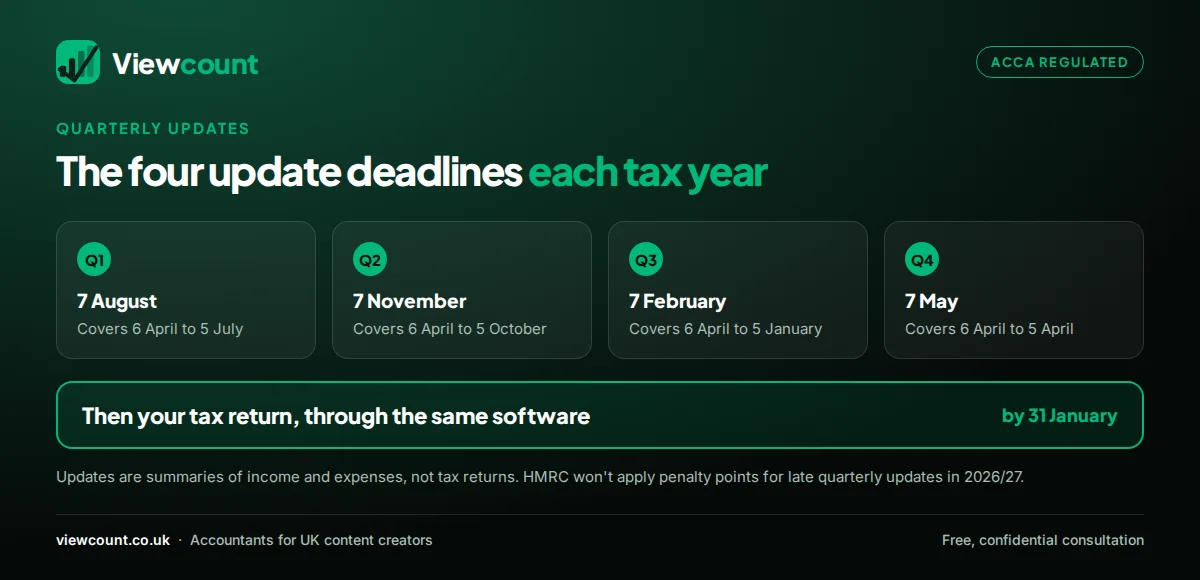
You can choose calendar quarters instead (to 30 June, 30 September, 31 December and 31 March), with the same four deadlines. You have to choose before you send your first update of the tax year.
What happens if you miss an update?
For the 2026/27 tax year, HMRC has said it will not apply penalty points for late quarterly updates. Late tax returns still earn points. After 2026/27, each missed update earns one point, and reaching four points brings a £200 penalty.
Not sure whether you're over the threshold, or which software to use? We'll check your figures and set you up. See our bookkeeping service.
Get in touchWhat should creators do now?
- Check your qualifying income on your last return: turnover from self-employment plus any rental income.
- If you're over £50,000 and haven't signed up, do it now. You should have started on 6 April 2026.
- If you're between £20,000 and £50,000, move to cloud bookkeeping this year so the change is painless when it reaches you.
- Keep claiming expenses properly. Digital records make it easier, not harder. See 10 tax-deductible expenses for creators.
FAQs
Sources
- GOV.UK: find out if and when you need to use Making Tax Digital for Income Tax
- GOV.UK: work out your qualifying income for Making Tax Digital for Income Tax
- GOV.UK: send quarterly updates
This article is general information for UK content creators based on HMRC rules and rates at the date reviewed. It is not personal tax advice; your circumstances may differ. Talk to us before acting on it.
Get ready for Making Tax Digital
We'll check whether it applies to you and set up your software and bookkeeping.
Book a free consultation