HMRC can go back 4, 6 or 20 years, depending on why the tax wasn't paid. Here's the part most articles leave out: if you never registered for Self Assessment, the starting point is 20 years, not 6. This guide covers the time limits, what it adds up to, and how to keep it down.
Key takeaways
- 4 years if you took reasonable care, 6 years if you were careless, 20 years if deliberate.
- Never registering when you should have (failure to notify) carries the 20-year limit unless you have a reasonable excuse.
- You pay the tax, late payment interest (7.75% a year from 9 January 2026) and a penalty.
- Coming forward before HMRC contacts you gives the lowest minimum penalty.
How far back can HMRC go?
| Why the tax was missed | How far back | Earliest tax year still open (Sept 2026) |
|---|---|---|
| Reasonable care, but still wrong | 4 years | 2022–23 |
| Careless, e.g. forgot an income stream | 6 years | 2020–21 |
| Deliberate, or never told HMRC you had taxable income | 20 years | 2006–07 |
What is the "failure to notify" trap?
If you earn more than the £1,000 trading allowance, you must tell HMRC you're self-employed by 5 October after the end of that tax year. Many creators never do, because it started as a hobby.
That puts you in the "failure to notify" category, which carries the 20-year limit. The one way back down to 4 years is a reasonable excuse, for example serious illness. Not realising you had to register is rarely accepted as one.
In practice, most creator income only goes back a few years, because TikTok and YouTube payouts only started recently. So the 20-year limit usually just means every year you've earned is open.
What does it add up to?
There are three layers:
- The tax itself: income tax and National Insurance on your profit, after expenses.
- Interest: charged daily from the original due date. Currently 7.75% a year (Bank of England base rate + 4%, from 9 January 2026).
- A penalty: a percentage of the tax, based on your behaviour and on whether you came forward before HMRC contacted you.
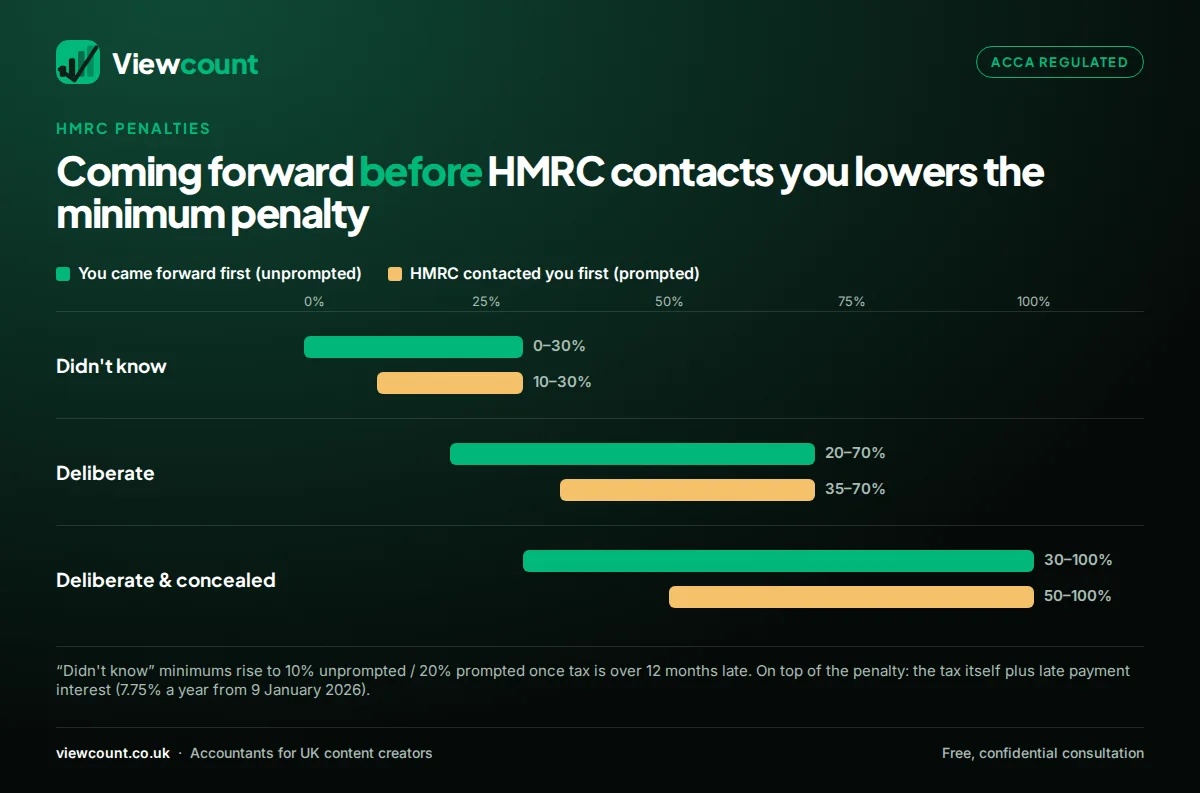
Within each range, the more you help HMRC (explaining what happened, giving full figures, providing records), the closer you get to the lower figure. For non-deliberate cases the minimums rise to 10% unprompted and 20% prompted once the tax is more than 12 months late. HMRC's disclosure guidance also says that if you leave it more than 3 years, your penalty reduction is limited.
Worked example
Illustration only. Alex, a TikTok creator, didn't realise they needed to register and owes £2,000 of tax a year for three years: £6,000 of tax, plus interest on each year. Most of that tax is more than 12 months late. If Alex comes forward unprompted, the minimum penalty is 10% of £6,000 = £600. If Alex waits for HMRC to make contact, the minimum doubles to 20% = £1,200, and it can reach 30% = £1,800. Your figures depend on your profits and other income.
Worried about past years? We'll work out what you actually owe, which may be less than you fear. See our Self Assessment service.
Get in touchWhat should you do now?
Time makes this worse, not better. Every year you wait adds interest, and a letter from HMRC can push you into the prompted column. Here's how to disclose, step by step.
FAQs
Sources
- HMRC Compliance Handbook CH56100: assessing time limits
- HMRC: your guide to making a disclosure
- HMRC interest rates for late and early payments
This article is general information for UK content creators based on HMRC rules and rates at the date reviewed. It is not personal tax advice; your circumstances may differ. Talk to us before acting on it.
Worried about past years?
We'll work out what you actually owe in a free, confidential call.
Book a free consultation