Yes. To a mortgage lender, a YouTuber, streamer or influencer is simply self-employed, so you apply for a self-employed mortgage like any other sole trader or company director, and plenty of lenders will lend to you. What they need is proof that your income is real and likely to last, which usually means two years of tax calculations from HMRC or two years of company accounts. This guide explains how lenders work out your income and how to get your paperwork ready.

Key takeaways
- Lenders treat YouTubers, streamers and influencers as self-employed. Where the money comes from matters less than how well you can prove it.
- Most lenders want two years of SA302 tax calculations and tax year overviews. Some will accept one year.
- Sole traders are assessed on profit, not turnover, usually averaged over two years or based on the lower of the latest year and the average.
- Limited company directors are usually assessed on salary plus dividends. Some lenders use salary plus their share of the company's profit instead.
- Many lenders accept a deposit of 5% to 10%, and the government-backed Freedom to Buy scheme supports 95% mortgages for eligible buyers.
- A sudden jump in income, income from many platforms and income paid in US dollars all need explaining, so preparation and a specialist broker help.
Can you get a mortgage as an influencer or YouTuber?
Yes. Lenders don't have a category for creators. They see a self-employed person (or a company director, if you trade through a limited company) and assess you on the figures you've declared to HMRC. In practice, an influencer or YouTuber mortgage is a standard self-employed mortgage.
The challenge is that creator income often looks unusual to an underwriter. It can jump sharply from one year to the next, arrive from several platforms and brands at once, and come from overseas. Lenders want to see longevity, not a single big year. A creator with steady, well-documented income will find it much easier than one with a recent spike and messy records.
What documents do you need for a self-employed mortgage?
Every lender sets its own rules, but most will ask for something close to this. Lloyds Bank, for example, says you might need "2 or more years of certified accounts or tax assessments".
| If you're a sole trader | If you trade through a limited company |
|---|---|
| SA302 tax calculations for the last 2 years | Full company accounts for the last 2 years |
| The matching HMRC tax year overviews | Your SA302s and tax year overviews |
| Recent personal and business bank statements | Payslips and dividend vouchers |
| Sometimes a letter or certificate from your accountant | Recent personal and business bank statements |
| Proof of ID and address | Often an accountant's certificate confirming your income |
You can download your SA302 and tax year overview from your HMRC online account for each of the last four years. GOV.UK suggests waiting 72 hours after filing your return, and checking that your lender accepts printed copies first.
Watch out
Lenders check that your SA302 matches the tax year overview, which shows what HMRC actually has on record. If you've amended a return, make sure both documents show the same final figures.
How do lenders work out a creator's income?
If you're a sole trader, lenders use your net profit: your income from AdSense, Creator Rewards, brand deals, affiliates and so on, minus your allowable expenses. Turnover doesn't count. Most lenders then take one of these:
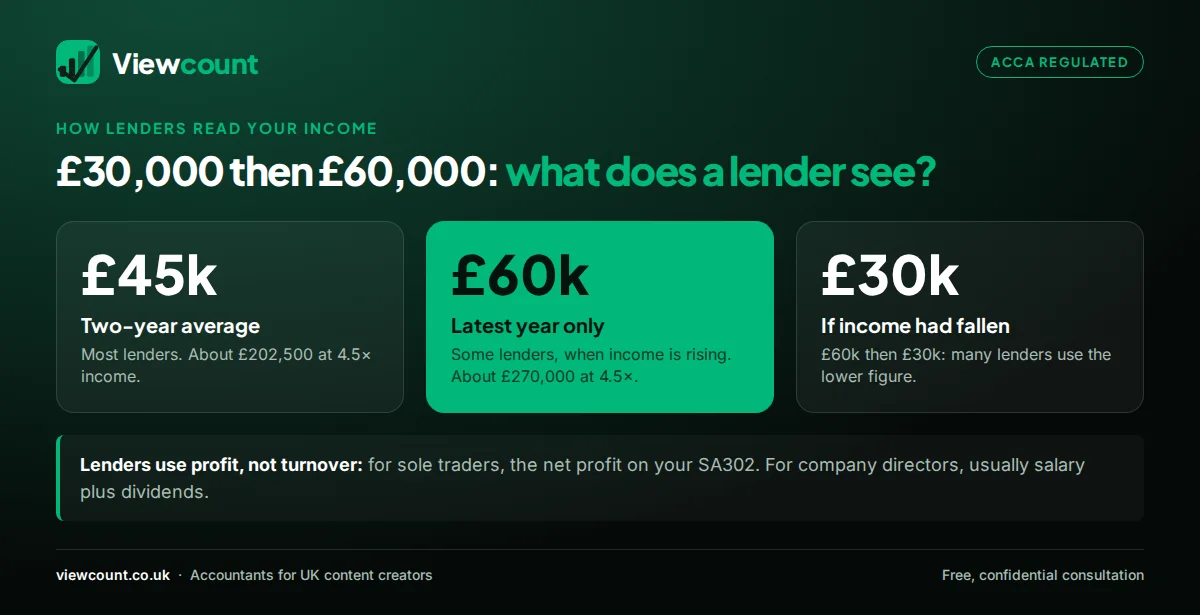
- The average of the last two years. This is the most common approach.
- The latest year, if your income is rising. Fewer lenders do this, but those that do can lend much more after a strong year.
- The lower of the latest year and the average, if your income has fallen.
Lenders then apply an income multiple, typically around 4 to 4.5 times, and run their own affordability checks on top. Some lenders go higher for larger incomes, but loans of 4.5 times income or more are rationed: under Bank of England rules, they can make up no more than 15% of new mortgages across the market. From 28 October 2026, individual lenders can go above that share as long as the market as a whole stays within it, which may open up more high-multiple lending for strong applicants.
"In our experience helping creators with mortgage applications, lenders typically lend around 4 to 4.5 times net profit, or salary plus dividends for company directors. The biggest mistake we see is creators only thinking about their mortgage once they've found a house. By then, their accounts are already set."
— Zakir Gire FCCA, Viewcount Accounting
Worked example
Illustration only. Amira is a sole trader whose profit was £30,000 in 2023/24 and £60,000 in 2024/25 after her channel took off. A lender that averages two years treats her income as £45,000, which at 4.5 times supports about £202,500. A lender that uses the latest year sees £60,000, which supports about £270,000. A broker who knows which lenders do what is worth a lot to Amira.
Your expenses lower your mortgage income
Because lenders use profit, every expense you claim reduces the income they see. That isn't a reason to stop claiming legitimate expenses: the tax you save is real money, and you should never understate costs to look better on paper. But if you're planning a big one-off purchase, such as a new camera setup or studio fit-out, talk to us about when it lands. Its timing can affect the figures your lender sees.
How are limited company directors assessed?
If you run your channel through a limited company, most lenders use your salary plus dividends, again usually averaged over two years. Because many creators keep their salary low and leave profit in the company, this can understate what you really earn.
Some lenders will instead use your salary plus your share of the company's net profit, in proportion to how many shares you own. For a creator who leaves money in the business, that can make a big difference.
Worked example
Illustration only. Kieran owns 100% of his company. He takes a salary of £12,570 and dividends of £37,430, so £50,000 in total. After corporation tax, his company made £90,000. A salary-plus-dividends lender sees £50,000. A lender that uses his share of net profit sees £12,570 + £90,000 = £102,570, roughly twice as much.
If you own less than about a quarter of the shares, some lenders treat you as an employee and look only at your payslips. If you're thinking about moving from sole trader to a limited company, it's worth knowing that a new company usually needs a year or two of accounts before lenders will use its figures. Our limited company accounts service includes planning your pay with this in mind.
How soon after going self-employed can you get a mortgage?
Usually once you have two years of accounts, but sometimes after one. A smaller group of building societies and specialist lenders will consider one full year of trading, usually where you have a strong year and a history in similar work. You'll have fewer lenders to choose from, so a broker matters even more. The high-street banks mostly want two years.
If you moved into full-time content creation from a job in a similar field, such as marketing, video production or photography, tell your broker. Lloyds notes that payslips from a past job may still count as evidence, and some lenders treat a related career history as part of your track record.
One practical point: you don't have to wait until January to file. Filing your return soon after 5 April gets you an SA302 for your latest, and often your best, year months earlier.
Planning to buy in the next year or two? We'll get your accounts, SA302s and income figures into the shape lenders want. See our Self Assessment service.
Get in touchHow much deposit do you need as a self-employed creator?
Being self-employed doesn't automatically mean you need a bigger deposit. Many lenders accept 5% to 10%, the same as for employed buyers, but a larger deposit gives you more lenders to choose from and better rates. If your income history is short or uneven, a 10% to 15% deposit can make the difference between a yes and a no.
| Deposit | What it usually means |
|---|---|
| 5% | Possible with some lenders, including through the government-backed Freedom to Buy scheme for eligible first-time buyers and home movers |
| 10% | A much wider choice of lenders and better rates |
| 15% or more | The best rates, and more room for a lender to accept a shorter or uneven income history |
Freedom to Buy permanently replaced the Mortgage Guarantee Scheme in July 2025. It supports 91% to 95% mortgages with participating lenders. Self-employed creators can use it, but you still need to pass the lender's normal income checks.
First-time buyers saving a deposit may also be using a Lifetime ISA, which adds a 25% government bonus on homes up to £450,000. The government has announced plans to replace it with a new first-time buyer ISA, so check the current rules before relying on it.
What makes creator income harder for lenders?
- Spikes. One big year followed by an application looks risky. Two consistent years look reliable.
- Many income streams. Ad revenue, brand deals, affiliates and gifts from different payers take more explaining. Clean records and a separate business bank account help.
- Overseas income. Lenders may treat income paid in US dollars or other currencies more cautiously. Declaring it properly on your return, and being able to show where it came from, is essential. See our W-8BEN guide for how US income is taxed.
- Platform type. Some lenders are cautious about income from adult content platforms. A broker will know which lenders accept it.
- Unpaid tax. Owing HMRC money, or being on a payment plan, will be picked up and can count against you.
Never inflate your income
Overstating your income on a mortgage application is fraud, and lenders check your figures directly against HMRC's records. If your income doesn't support the loan you want, the answer is better planning, not better-looking numbers.
How should you prepare before applying?
- File every return on time, and file early in the year you plan to apply.
- Pay your tax on time and clear any arrears.
- Keep business and personal money separate. It makes your bank statements far easier to read.
- If you have a company, plan your salary and dividends with your accountant, with the mortgage in mind.
- Use a broker who handles self-employed cases, and give them clean accounts and an accountant's reference from the start.
We're accountants, not mortgage advisers. We prepare your figures and documents and work alongside your broker, who recommends the mortgage itself.
FAQs
Sources
- GOV.UK: get your SA302 tax calculation
- Bank of England: PS19/26 high loan to income lending (October 2026)
- Lloyds Bank: getting a mortgage while self-employed
- Mortgage Professional Adviser: UK launches permanent mortgage guarantee scheme
- Yorkshire Building Society: getting a mortgage while self-employed
This article is general information for UK content creators based on HMRC rules and rates at the date reviewed. It is not personal tax advice; your circumstances may differ. Talk to us before acting on it.
Get mortgage-ready
We'll prepare your accounts and income figures so your broker can find the right lender.
Book a free consultation